
It is common for children to struggle with English at different stages of their education. A few low marks in grammar, a poorly structured essay, or difficulty understanding a reading passage does not automatically mean a child needs private tuition. Sometimes, additional practice and clearer instructions are enough to help them improve.
However, when the same difficulties continue despite regular homework and parental support, there may be a deeper skills gap. A child might read fluently but struggle to understand the text, speak confidently but find writing difficult, or repeatedly make grammar mistakes even after correction.
Recognizing these patterns can help parents decide whether their child needs more practice or targeted English support. Here are the signs to watch for and how to determine the right next step.
Extra Homework Does Not Always Fix a Skills Gap
Extra homework can be useful when a child understands a concept but needs more practice applying it. For example, a student who understands punctuation but occasionally forgets capital letters may improve through short, focused exercises.
A skills gap is different. It occurs when a child has not fully understood a concept or developed a particular ability. Giving them more worksheets without addressing the underlying problem may simply reinforce the same mistakes.
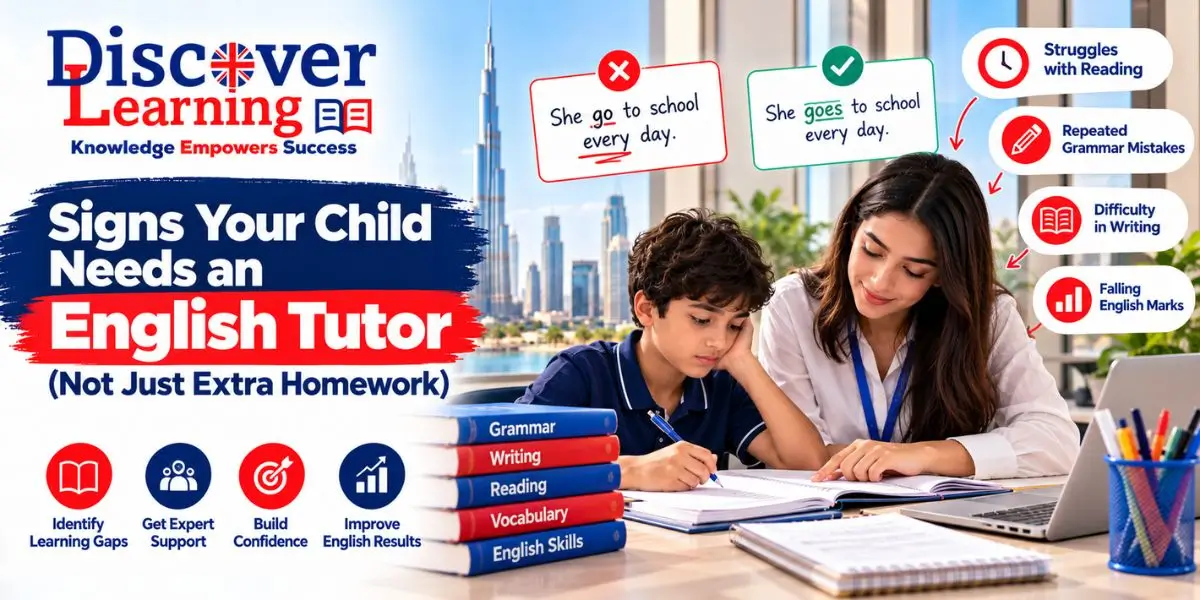
Consider a child who repeatedly writes sentences such as “She goes to school every day.” Asking them to complete ten more grammar questions may not help if they do not understand subject-verb agreement.
In this situation, the child needs a clear explanation, examples, guided practice, and opportunities to apply the rule in different sentences.
The important question is not how much homework your child completes. It is whether they understand the skill they are practicing and can use it independently.
Seven Signs Your Child May Need English Support
1. Reading Remains Slow and Effortful
Some children find reading difficult even after years of classroom instruction. Younger students may guess unfamiliar words, skip difficult sections, or rely heavily on pictures to understand a story. Others read so slowly that they lose track of the meaning.
As children progress through school, these difficulties can affect more than English lessons. Students need to read instructions, understand textbooks, interpret questions, and process information across different subjects.
Watch for patterns such as:
- Your child avoids reading independently.
- They frequently skip or guess unfamiliar words.
- Reading a short passage takes much longer than expected.
- They become frustrated when asked to read aloud.
- They struggle to explain what they have just read.
Occasional difficulty with a new word is normal. Persistent reading problems, however, deserve attention. If difficulties continue despite regular practice, a suitable assessment can help identify whether the child needs support with decoding, fluency, vocabulary, or another reading skill.
2. Your Child Can Read a Text but Cannot Explain It
Reading words correctly does not necessarily mean understanding their meaning.
A child might finish a passage without being able to identify its main idea, explain why a character acted in a particular way, or connect information from different paragraphs. They may also reread the same section several times without understanding what it says.
These difficulties can become more noticeable as schoolwork becomes more demanding. Students are increasingly expected to interpret information, draw conclusions, compare viewpoints, and support their answers with evidence.
Parents can check comprehension by asking simple questions after reading together:
- What was the main idea?
- Why do you think the character made that decision?
- Which details support your answer?
- Can you explain the passage in your own words?
If your child can repeat sentences but struggles to explain their meaning, they may need focused practice in reading comprehension rather than additional reading time alone.
3. Spoken English Is Stronger Than Written English
Some children communicate confidently in conversation but struggle when asked to write a paragraph, story, or essay.
They may explain an idea clearly when speaking, yet produce short sentences, repeat the same vocabulary, or struggle to organize their thoughts on paper. Their writing may also contain grammar, spelling, and punctuation mistakes that do not appear as often in conversation.
This difference is understandable because writing requires several skills to work together. Students must develop ideas, choose appropriate vocabulary, construct sentences, apply grammar rules, organize paragraphs, and check their work.
To help at home, ask your child to explain an idea verbally before writing it down. Then encourage them to turn that explanation into a paragraph with a clear opening sentence, supporting details, and a conclusion.
If the gap between spoken and written English remains significant, targeted instruction can help your child develop the skills needed to express ideas more clearly in writing.
4. The Same Grammar Mistakes Keep Appearing
Every student makes mistakes while learning a language. The concern arises when the same errors continue after repeated correction and practice.
For example, your child may understand that “She goes to school” should be “She goes to school” when reviewing an exercise. However, they may make the same mistake in a story or examination answer a few days later.
Recurring problems can involve:
- Subject-verb agreement
- Verb tenses
- Sentence structure
- Punctuation and capitalization
- Spelling and word choice
- Articles and prepositions
These patterns may indicate that the child can recognize a correction but has not yet learned to apply the rule independently.
Instead of correcting every mistake without explanation, focus on one or two recurring issues at a time. Explain the rule, provide examples, and ask your child to identify and correct similar errors in their own writing.
If the mistakes continue across different assignments, structured support may help them understand the rules and apply them more consistently.
5. English Becomes More Difficult as Schoolwork Advances
A child who performs reasonably well in primary school may begin to struggle when English assignments become more analytical.
At higher grade levels, students are often expected to analyze literary techniques, compare perspectives, interpret themes, evaluate arguments, and support their ideas with relevant evidence. Simply identifying information from a text is no longer enough.
This transition can be particularly challenging for students following IGCSE, A-Level, IB, or other academically demanding curricula.
Your child may understand a novel or article but struggle to explain how the writer creates an effect. They might have a relevant argument but find it difficult to structure an essay or use quotations effectively.
In these cases, the solution is not necessarily more grammar worksheets. The student may need help with analytical reading, essay planning, paragraph development, evidence selection, or examination technique.
The earlier these gaps are identified, the easier it can be to address them before they affect performance across multiple assignments.
6. English Homework Is Causing Increasing Frustration
A child’s attitude towards English can provide useful clues about their learning experience.
If your child regularly avoids reading, becomes upset when writing essays, or says they are simply bad at English, it is worth investigating what is causing the frustration.
Repeated difficulty can affect confidence. A child who has struggled with reading comprehension for months may begin avoiding reading tasks because they expect to get the answers wrong.
Look for changes such as:
- Regular arguments over English homework
- Avoiding reading or writing assignments
- Becoming unusually anxious about tests
- Giving up quickly when a task feels difficult
- Depending on a parent to explain almost every question
These behaviors do not automatically mean your child needs a tutor. Tiredness, workload, teaching methods, and other factors may also contribute.
However, when frustration is closely linked to a recurring English difficulty, identifying the missing skill can help make learning more manageable.
7. Your Child Needs Too Much Help to Complete Assignments
Parental support is valuable, especially when children are developing new academic skills. However, there is a difference between helping a child understand a task and guiding them through every sentence or answer.
You may notice that your child can complete homework only when you explain the instructions, correct each sentence, suggest vocabulary, or organize their paragraphs for them.
Although the finished assignment may look good, it may not accurately reflect what your child can do independently.
Try stepping back gradually. Ask your child to explain the task, plan an answer, and attempt the first section without assistance. Review the work afterwards and identify where they became stuck.
If they consistently need extensive help with the same types of tasks, they may benefit from targeted instruction that builds independence rather than simply helping them finish their homework.
When Is Extra English Practice Enough?
Private tuition is not necessary for every child who makes mistakes. In many cases, regular practice at home can produce meaningful improvement.
Extra practice may be enough when your child:
- Understands the concept but occasionally forgets to apply it.
- Corrects mistakes after a simple reminder.
- Improves when given more time to complete a task.
- Can explain their answers when prompted.
- Shows steady progress with short, focused exercises.
Parents can support progress through a simple routine:
Read together for 15 minutes: Choose material suited to your child’s reading level and discuss its meaning.
Build vocabulary in context: Encourage your child to use unfamiliar words in their own sentences rather than memorising definitions alone.
Practise one writing skill at a time: Focus on paragraph structure, sentence variety, punctuation, or another specific area instead of correcting everything at once.
Review recurring mistakes: Keep a short list of common errors and revisit them in new writing tasks.
Encourage independent correction: Ask your child to reread their work and identify possible improvements before you provide feedback.
Review their progress over several weeks. If the same difficulties persist despite consistent practice, consider whether a more structured approach is needed.
When Does an English Tutor Become More Useful?
An English tutor can be helpful when a child needs more than additional exercises or occasional explanations. The goal should be to identify the underlying difficulty and teach the missing skill systematically.
Consider seeking support if your child continues to struggle with reading, comprehension, grammar, writing, or school assessments despite regular practice.
Working with English tutors can give students opportunities to ask questions, receive individual feedback, practice specific skills, and address misunderstandings at a suitable pace.
Before arranging tuition, look for an approach that considers your child’s current abilities rather than relying only on their school grade or examination results.
For example, two students in the same year group may both receive low marks in English for entirely different reasons. One may struggle to understand reading passages, while the other understands the material but cannot organize an analytical essay.
The support they need will be different. A useful starting point is an assessment that identifies their strengths, weaknesses, and most important learning priorities.
How Discover Learning Tutors Identifies English Learning Gaps
Discover Learning Tutors provides academic support for students across different age groups, school systems, and ability levels in Dubai. When a child struggles with English, the first step should be to understand which skills are affecting their performance.
Depending on the student’s needs, support may focus on:
- Reading fluency and comprehension
- Grammar and sentence construction
- Vocabulary development
- Paragraph and essay writing
- Academic reading and analytical skills
- Examination preparation and answering techniques
A focused assessment can help establish where the child is struggling and which areas require attention first. This also helps determine whether the student would benefit from individual tuition, a small-group setting, or targeted examination preparation.
The teaching approach should reflect the child’s age, current ability, curriculum, and learning goals. Younger students may need structured activities and guided practice, while older students may benefit from essay feedback, text annotation, and examination-style questions.
Discover Learning Tutors offers in-person and online learning options, allowing families to consider the format that best suits their circumstances. Students who need flexible scheduling may prefer online sessions, while others may respond better to face-to-face interaction.
For parents comparing academic support options, choosing among the available tutors in Dubai should involve more than checking qualifications or lesson prices. It is also important to understand how the tutor identifies learning gaps, measures progress, and adapts instruction when a student is not improving.
The objective is to address the right problem, build confidence, and help the child become more independent over time.
What Parents Should Do Next
If you suspect your child is struggling with English, begin by reviewing their recent schoolwork and teacher feedback. Look for recurring patterns rather than focusing on one low mark or an isolated mistake.
Ask yourself three questions:
- Does my child understand the skill but need more practice?
- Do the same mistakes continue even after I explain the correct approach?
- Is the difficulty affecting confidence, homework independence, or school performance?
If your child improves with reminders and focused practice, a consistent home routine may be sufficient. If the same problems persist, an assessment can help identify what needs to change.
It is also worth speaking with your child’s teacher to understand whether the difficulty appears in class, homework, or assessments. If reading problems are persistent or unusually pronounced, ask whether a more specialized evaluation may be appropriate.
Parents should also consider the child’s wider academic needs. If English is only one of several subjects causing difficulty, a coordinated plan may be more effective than treating each subject in isolation. Families seeking support across subjects can also look into math tutors in Dubai when mathematics requires separate attention.
The key is to avoid assuming that more homework will automatically lead to better results. Children often make better progress when practice is matched to the skill they actually need to develop.
If you are unsure where your child is struggling, Discover Learning Tutors can assess their current English skills and help create a targeted learning plan based on the areas that need the most support.
Book an English assessment with Discover Learning Tutors to understand whether your child needs more practice or a different kind of support.
Frequently Asked Questions
How do I know if my child needs an English tutor?
Look for persistent difficulties with reading comprehension, writing, grammar, or school assessments. If the same problems continue despite regular practice and feedback, an assessment may help identify the underlying skills gap.
Can extra homework improve my child’s English?
Yes, when your child understands the concepts and needs more opportunities to practice. If they repeatedly make the same mistakes without understanding why, targeted teaching may be more useful than additional worksheets.
At what age should a child start English tuition?
There is no single age that applies to every child. Support may be useful whenever a persistent difficulty begins affecting learning or confidence. The right approach depends on the child’s age, current skills, and educational needs.
Should I choose online or in-person English tuition?
Both formats can work well. Online tuition may offer scheduling flexibility, while in-person lessons provide face-to-face interaction. Consider your child’s learning preferences, the type of support required, and the tutor’s teaching approach.
How can an English tutor help with school examinations?
Depending on the student’s needs, a tutor can help with comprehension, essay planning, grammar, analytical writing, time management, and answering questions according to examination requirements. The most effective preparation focuses on the student’s specific weaknesses rather than practicing questions without reviewing mistakes.