Choosing IGCSE subjects can feel like a major decision, especially when students are around 14 or 15 years old. Their choices can influence which A-Level or IB subjects they can study later and may affect their options when applying to university.
However, students do not need to decide their entire career at this age. The goal is to build a strong academic foundation, choose subjects that match their abilities and interests, and avoid closing important pathways unnecessarily.
For families in Dubai, the process involves more than selecting subjects from a list. Students must consider their school’s available options, possible post-16 pathways, future university requirements, and any applicable UAE curriculum requirements.
This guide explains how IGCSE subject choices work, which combinations may suit different academic interests, and what parents should check before making a final decision.
How Do IGCSE Subject Choices Work?
Cambridge IGCSE is designed primarily for students aged 14 to 16 and offers a flexible range of academic subjects. Schools select which subjects they offer and organize their own timetables and subject combinations.
As a result, there is no single combination that every Cambridge IGCSE student worldwide must follow.
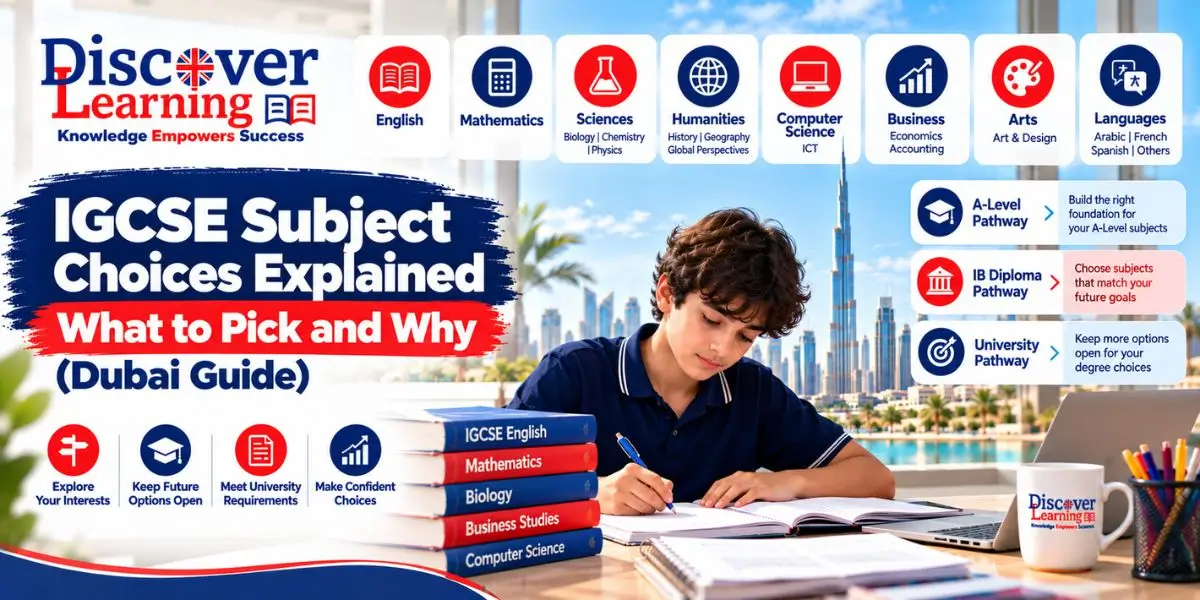
Many schools build a broad academic program around subjects such as:
- English
- Mathematics
- Biology, Chemistry, and Physics, or combined science options
- A humanities subject
- A language
- Additional optional subjects based on student interests and school availability
Other possible choices include business studies, economics, accounting, computer science, ICT, geography, history, global perspectives, and art and design.
Not every school in Dubai offers every subject, and some subjects may have specific entry requirements or timetable restrictions.
The first step in choosing IGCSE subjects is to review your school’s actual options booklet. It should explain which subjects are compulsory, which are optional, and whether any combinations are restricted.
Core Subjects vs Optional IGCSE Subjects
Parents sometimes assume that Cambridge requires every student to take exactly the same core subjects. In practice, requirements depend on the school and the curriculum pathway being followed.
English and mathematics are commonly included in school programs, while science requirements and optional subject choices vary.
Optional subjects allow students to build a combination that reflects their academic strengths, interests, and potential future plans.
For example, a student interested in engineering may want to prioritize mathematics and physics, while a student interested in business may consider economics or business studies alongside a balanced academic foundation.
Before choosing optional subjects, ask the school:
- Which subjects must every student take?
- Which subjects can students choose freely?
- Are there minimum grades or other entry criteria?
- Can students change a subject later if their interests develop?
- Are there timetable restrictions that affect subject combinations?
These questions help prevent students from selecting a combination that looks suitable on paper but is not available or practical at their school.
IGCSE Subject Choices in Dubai: UAE Curriculum Requirements
Students attending private schools in Dubai may have additional UAE curriculum requirements alongside their British or international academic program.
Depending on the student’s circumstances and the applicable school requirements, subjects such as Arabic, Islamic Education, UAE Social Studies, and Moral Education may be relevant.
The exact requirements can depend on factors such as nationality, religion, year group, curriculum, and current education regulations.
Parents should confirm the applicable requirements directly with their school and check the latest guidance from the Knowledge and Human Development Authority (KHDA) where relevant.
It is important to distinguish these requirements from the optional Cambridge IGCSE subjects listed in a school’s examination options booklet. The two may be organized differently within the timetable.
How IGCSE Choices Affect A-Level Subjects
IGCSE subject selection becomes particularly important when a student wants to continue a subject at A-Level.
A-Level courses are generally more specialised than IGCSE courses. Schools may set minimum IGCSE grades for entry, particularly in subjects that require strong prior knowledge.
For example, a student hoping to study A-Level Chemistry should check the school’s chemistry entry requirements and ensure they have the appropriate science foundation. A student considering mathematics or physics should also check the relevant prerequisite knowledge and grade expectations.
A practical way to plan is to work backwards:
Possible university degree → likely A-Level subjects → useful IGCSE foundation
You do not need to choose a university degree at 14. However, if you already have an interest in medicine, engineering, computing, economics, or another specialist field, it is worth checking which subjects may be needed later.
For instance:
- Medicine and health-related degrees: Biology and Chemistry are useful foundations, although exact university prerequisites vary.
- Engineering: Mathematics and physics are often important, with chemistry relevant to some pathways.
- Computer science: Mathematics and computer science can provide useful preparation, depending on the intended course.
- Economics: Mathematics is important for many university economics degrees, particularly more quantitative programs.
- Law and humanities: English, history, geography, and other subjects that develop reading, writing, and analytical skills can provide useful preparation.
These are general planning examples, not universal admission rules. Always check the requirements of your intended A-Level provider and prospective universities.
How IGCSE Choices Affect the IB Diploma
Students considering the IB Diploma should also think about their IGCSE subject choices, particularly if they already have an idea of which subjects they may take at Standard Level or Higher Level.
The IB Diploma has a different structure from A-Levels. Students generally study subjects across several subject groups, with choices shaped by their school’s IB offering and the program’s requirements.
The IB does not impose one universal rule that every student must have taken a matching IGCSE subject before entering every IB course. However, individual schools may set their own entry criteria, especially for demanding higher-level subjects.
Previous knowledge can also make a significant difference to a student’s readiness.
For example, a student who wants to study IB Higher Level Chemistry, Physics, Biology, or Mathematics should check the school’s expectations for prior knowledge and achievement.
When selecting IGCSE subjects, consider three things:
- Which IB subjects might the student want to take later?
- Does the school require particular IGCSE subjects or grades for those courses?
- Will the student’s choices provide a suitable foundation for the intended level?
The aim is to prepare for future study without choosing subjects solely because they seem prestigious or difficult.
Common IGCSE Subject Combinations for STEM Students
Students interested in science, technology, engineering, mathematics, or medicine usually benefit from maintaining a strong foundation in mathematics and relevant sciences.
A possible STEM-oriented combination might include:
English + Mathematics + Biology + Chemistry + Physics + Computer Science + a humanities subject or language
This is only an example. Students should adapt their choices to the subjects offered by their school, their academic strengths, and their intended post-16 pathway.
If Your Child Is Interested in Medicine
Biology and Chemistry can provide useful foundations for later study. Mathematics and strong English skills also help develop the analytical and communication abilities needed for demanding academic programs.
However, university medical schools may have specific A-Level or equivalent subject requirements, so parents should check these before finalizing choices.
If Your Child Is Interested in Engineering
Mathematics and physics are particularly relevant to many engineering pathways. Chemistry may also be useful or required for certain specializations.
Students should check which A-Level subjects and grades their intended universities expect, then work backwards to identify the appropriate IGCSE foundation.
If Your Child Is Interested in Computer Science
Mathematics is an important consideration, especially for degrees with a strong theoretical or mathematical focus. Computer Science can provide relevant knowledge, but it is not a universal prerequisite for every university computing course.
A student should not assume that taking computer science at IGCSE is mandatory everywhere. The intended A-Level and university requirements should guide the final decision.
Common IGCSE Subject Combinations for Business and Humanities
Students interested in business, economics, law, communications, social sciences, or humanities may prefer a broader combination that develops analytical thinking, communication, and research skills.
A possible combination might include:
English + Mathematics + Science + History or Geography + Business Studies or Economics + a language + another elective
The exact subjects should reflect the student’s strengths and likely next steps.
Business Studies vs. Economics
Students sometimes assume they must take both business studies and economics to pursue a business-related career. That is not necessarily the case.
Business studies generally focuses on how organizations operate and make decisions, while economics examines how individuals, businesses, markets, and economies allocate resources.
Both can be useful, but students should consider which subject they enjoy and whether either is recommended or required for their intended A-Level or university pathway.
Does a Future Law Student Need IGCSE Law?
Usually, students do not need to take an IGCSE subject called Law to keep a law degree open.
English, humanities, analytical reading, argumentation, and structured writing can provide useful preparation. However, university entry requirements vary, so students should check the academic criteria for their intended destination.
What If Your Child Has Not Chosen a Career Yet?
That is perfectly normal.
A balanced combination that maintains mathematics, English, suitable science options, and a mix of humanities or languages may preserve flexibility, depending on the school’s requirements and available choices.
Rather than guessing which career will suit your child, focus on their strengths, interests, and the subjects they may realistically want to continue after IGCSE.
Should Students Choose Subjects They Enjoy or Subjects They Need?
Both matter, and the best decisions usually consider them together.
Interest can help students remain motivated, participate more actively, and develop their skills over time. Future academic requirements matter because dropping an important subject may make some later pathways more difficult to access.
Before making a final choice, consider these four questions:
- What are the student’s strengths? Review previous results, teacher feedback, and the areas in which the student performs confidently.
- Which subjects genuinely interest them? Consider whether they enjoy the actual content and style of assessment, not just the subject name.
- What may be required later? Check potential A-Level, IB, and university entry criteria.
- Which combination keeps suitable options open? Avoid narrowing choices unnecessarily if the student is still undecided.
Choosing a subject simply because friends are taking it is rarely a strong reason. Likewise, choosing a subject only because it is perceived as easy can create difficulties if it removes access to a course the student later wants to pursue.
Students should also consider workload. A combination that is academically appropriate but unmanageable for the individual may not be the best choice.
What Is the Difference Between Core and Extended IGCSE Papers?
The terms “core subjects” and “optional subjects” should not be confused with the core and extended curriculum routes available in some Cambridge IGCSE subjects.
In subjects where these routes are offered, the core curriculum covers a narrower range of content and is designed for students targeting the relevant lower-to-middle grading range. The extended curriculum includes additional content and provides access to higher grades.
The availability of these routes and the grades candidates can achieve depend on the subject and syllabus.
Students do not necessarily need to follow the same route in every subject. Their school should advise which route is appropriate based on current performance, future goals, and the relevant examination requirements.
Parents should ask how the choice may affect the student’s maximum available grade and eligibility for later courses.
How Can Academic Tutoring Help After IGCSE Subjects Are Chosen?
Once the subject combination is finalized, the next priority is helping the student build the knowledge and skills required to perform well.
Tutoring is most useful when it addresses a specific learning gap rather than simply adding more hours of homework.
For example, a student may choose physics because it supports a future engineering pathway but struggle with calculations and applying formulas. Another student may enjoy history but lose marks because their essays lack clear arguments and supporting evidence.
Academic support may focus on:
- Strengthening foundational knowledge.
- Understanding difficult concepts.
- Applying knowledge to unfamiliar questions.
- Improving written structure and explanations.
- Developing examination technique.
- Managing time during assessments.
- Identifying and correcting recurring mistakes.
DLT’s curriculum-aligned approach can be discussed in relation to a student’s academic needs and IGCSE requirements. Families should confirm current subject availability, tutor expertise, and lesson options when making an inquiry, particularly for specialist subjects.
The important point is to identify what is preventing progress and choose support that directly addresses it.
A Parent Checklist for Choosing IGCSE Subjects
Before submitting the final subject choices, review the following checklist with your child.
- Have we confirmed which subjects are compulsory at the school?
- Have we reviewed the actual optional subjects available?
- Do we understand any timetable restrictions or subject combinations?
- Have we checked the entry requirements for likely A-Level or IB subjects?
- Have we considered university prerequisites if a potential degree requires specific subjects?
- Does the combination reflect the student’s strengths and interests?
- Will the overall workload be manageable?
- Have we checked any applicable UAE curriculum requirements?
- Does the student need additional academic support in a subject they intend to continue?
- Do we know whether the school permits subject changes later and under what conditions?
This process is more useful than searching for a single perfect combination. The right choices depend on the individual student, the school’s available options, and the pathways they may want to pursue.
Choosing the Right IGCSE Subjects in Dubai
The strongest IGCSE subject choices balance current ability, genuine interest, and future flexibility.
Students considering STEM should pay particular attention to mathematics and relevant science foundations. Those interested in business or humanities can choose combinations that develop analytical thinking, communication, and subject knowledge. Students who remain undecided should consider a balanced selection that keeps realistic options open.
Parents comparing academic support options or English tutors should also consider the student’s wider learning needs, especially if English comprehension, essay writing, or examination technique is affecting performance across several subjects.
If your child is planning future university applications, an Ielts private tutor may become relevant later if English proficiency testing is required. IELTS preparation is separate from choosing IGCSE subjects, so confirm the university’s accepted tests and requirements when the time comes.
When considering tutors in Dubai, check whether the teaching matches the student’s curriculum, whether the tutor can identify specific learning gaps, and how progress will be reviewed.
If your child has selected their IGCSE subjects but is struggling in one or more areas, contact DLT to discuss curriculum-aligned academic support based on their learning needs and academic goals.
Good subject choices help keep opportunities open. Consistent preparation helps students build the knowledge and confidence to make the most of them.