
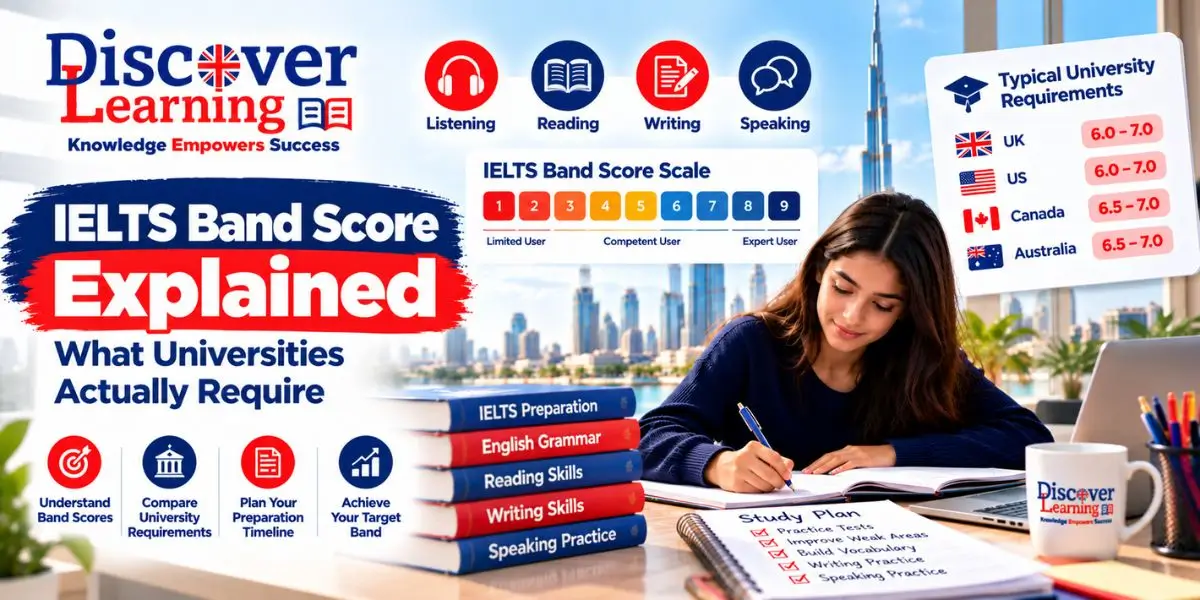
Getting your IELTS result is only one part of applying to an international university. The next step is understanding whether your score meets the English language requirements for your chosen degree.
For many students, the confusing part is knowing whether an overall IELTS Band 6.0, 6.5, or 7.0 is enough. Some universities also require minimum scores in individual sections, meaning you could achieve the required overall band and still fall short of the admission criteria.
As a general guide, IELTS Academic requirements for university admission often fall between Band 6.0 and 7.0, although some programs require higher scores. The exact requirement depends on the institution, degree, and applicant category. For example, Arizona State University lists 6.0 as its general undergraduate IELTS Academic minimum, while the University of British Columbia requires 6.5 overall with no component below 6.0.
This guide explains how IELTS band scores work, what universities in the UK, US, Canada, and Australia may require, and how to set a realistic preparation target.
How Does the IELTS Band Score Work?
IELTS uses a nine-band scale to describe English proficiency. Candidates receive separate scores for listening, reading, writing, and speaking, along with an overall band score calculated from the average of these four components.
For example, consider the following results:
| IELTS section | Score |
| Listening | 7.0 |
| Reading | 7.0 |
| Writing | 6.0 |
| Speaking | 6.0 |
| Overall IELTS band | 6.5 |
The four scores average 6.5, so the overall result is Band 6.5.
IELTS calculates the average of the four component scores and rounds it to the nearest whole or half band according to its official scoring rules.
IELTS Band Score Chart
| Band score | IELTS description |
| 9 | Expert user |
| 8 | Very good user |
| 7 | Good user |
| 6 | Competent user |
| 5 | Modest user |
| 4 | Limited user |
| 3 | Extremely limited user |
| 2 | Intermittent user |
| 1 | Non-user |
| 0 | Did not attempt the test |
These descriptions indicate general English proficiency. They do not determine university admission on their own.
A university may accept Band 6.0 for one course but require Band 7.0 or higher for another. You should therefore use the band descriptions to understand your result, then compare that result with your target program’s published requirements.
Why Your Overall IELTS Score Is Not Always Enough
One of the most important details in university applications is the difference between an overall band requirement and a minimum component requirement.
Suppose a university requires:
- Overall IELTS Academic: 6.5
- Listening: at least 6.0
- Reading: at least 6.0
- Writing: at least 6.0
- Speaking: at least 6.0
A candidate with an overall 6.5 but a writing score of 5.5 would not meet these stated requirements.
This is why you should check all four components rather than focusing exclusively on the overall result.
For example, UCL uses different English proficiency levels for undergraduate admission. Its published IELTS Academic requirements range from 6.5 overall with at least 6.0 in each component at Level 1 to 8.0 overall with 8.0 in each component at Level 5. The level required depends on the specific program.
Before booking your exam, record the minimum score required for each section, not just the overall band.
What IELTS Score Do UK Universities Require?
UK universities set their own English language requirements, and different courses at the same institution may have different thresholds.
A useful example is University College London (UCL), which uses five English proficiency levels for undergraduate applicants. Its requirements vary according to the program, with higher levels requiring stronger overall performance and, in some cases, higher component scores.
As an initial planning guide, students researching UK universities may encounter requirements such as:
- Band 6.0 to 6.5: Some institutions and courses accept scores in this range.
- Band 6.5 to 7.0: A useful planning range for many university applications, depending on the program.
- Band 7.0 to 7.5 or higher: May be required for courses with more demanding English language criteria.
These ranges are not universal admission rules. The requirement for your specific degree takes priority over any general estimate.
When researching UK universities, check the course page, accepted IELTS test type, minimum component scores, and deadline for submitting English language evidence.
What IELTS Score Do US Universities Require?
IELTS requirements in the United States vary by university and academic program.
For example, Arizona State University lists an IELTS Academic overall minimum of 6.0 for its general undergraduate English proficiency requirement. Certain programs have higher thresholds, including 6.5 for specified engineering programs and 7.0 for specified journalism programs.
The University of Southern California recommends an IELTS score of 7.0 for international undergraduate applicants.
These examples demonstrate why students should not assume that all US universities follow the same minimum.
If you are researching IELTS for UK/US universities, create a shortlist and record the exact English requirements for each degree. Also check whether the university publishes a minimum score for every section or only an overall threshold.
Meeting the English language requirement is one part of an application. It does not guarantee admission, which may also depend on academic results and other selection criteria.
What IELTS Score Do Canadian Universities Require?
A number of Canadian universities use an overall IELTS Academic requirement of 6.5 with minimum component scores, but requirements can vary by institution and programme.
The University of British Columbia, for example, requires IELTS Academic 6.5 overall with no component below 6.0 for its standard English language admission standard. Its published requirements also distinguish between regular admission and certain alternative pathways.
For postgraduate applicants, it is particularly important to check the individual department or graduate program. A university-wide minimum may not cover every master’s or doctoral degree.
Before applying, confirm:
- The overall IELTS score required.
- The minimum score in each section.
- Whether the requirement differs for undergraduate and postgraduate study.
- Whether the program has additional language requirements.
- The deadline by which valid results must be submitted.
A score that meets the university’s general standard may not be sufficient for every course.
What IELTS Score Do Australian Universities Require?
Australian universities also set requirements according to the institution and degree.
The University of Sydney lists a standard English language requirement of IELTS Academic 6.5 overall with no band below 6.0, while some courses and faculties have different requirements. It also specifies that English test results must meet its validity rules.
This means applicants should check the specific course page instead of relying exclusively on the university’s general admission information.
Some programs, including certain health, education, law, and professionally accredited courses, may have additional English language requirements.
If you are considering Australia, confirm the accepted test, overall score, component minimums, and validity period before scheduling your exam.
IELTS Academic or General Training for University Admission?
For most undergraduate and postgraduate university applications, IELTS Academic is the relevant test. However, you should always check the accepted test type with your chosen institution.
IELTS Academic assesses English skills relevant to higher education and academic environments. IELTS General Training focuses on language skills used in everyday, workplace, and broader social contexts.
Listening and speaking are the same in both versions, but the reading and writing components differ.
Do not assume that IELTS General Training will be accepted for a degree simply because your numerical band score meets the stated minimum. Confirm the required version before registering for the exam.
Also check whether the institution accepts IELTS Online, One Skill Retake, or other test arrangements. Acceptance rules differ, and some universities restrict particular formats or results.
Is a Score 0.5 Below the IELTS Requirement Close Enough?
Usually, you should treat a published minimum as a firm requirement unless the university confirms otherwise.
Imagine your chosen course requires:
Overall, Band 6.5, with no component below 6.0.
If your result is:
- Listening: 7.0
- Reading: 7.0
- Writing: 5.5
- Speaking: 6.5
- Overall: 6.5
You have achieved the overall band but have not met the minimum Writing requirement.
Similarly, an overall 6.0 is not automatically accepted for a course requiring 6.5.
However, a score below the direct-entry requirement does not necessarily end your plans. Some universities offer approved English preparation courses, conditional admission arrangements, or pathway programmes for eligible applicants.
For example, UBC publishes separate requirements for its Conditional Admission Program, which differ from the standard undergraduate English Language Admission Standard.
Check whether your university offers a formal alternative pathway, whether you are eligible, and whether completing it would satisfy the English language requirement for your intended degree.
Do not assume that a lower score will be accepted without confirmation from the institution.
How Long Does It Take to Reach Your Target IELTS Band?
Your preparation timeline depends on the difference between your current English proficiency and the score you need.
A student already performing at Band 6.5 and targeting Band 7.0 may need a different plan from someone starting at Band 5.0 and aiming for Band 7.0.
The following estimates can help with initial planning:
| Current score and target | Illustrative preparation window |
| Band 6.5 to 7.0 | Around 4 to 8 weeks |
| Band 6.0 to 6.5 | Around 4 to 8 weeks |
| Band 5.5 to 6.5 | Around 8 to 12 weeks or longer |
| Band 5.0 to 7.0 | Several months may be needed |
These are broad planning estimates, not guaranteed improvement timelines. Progress depends on your existing English skills, weekly study time, individual section scores, feedback quality, and consistency.
For example, a candidate with Listening 7.5 but Writing 5.5 may need to spend substantially more time on writing than another candidate who scores around 6.0 in every component.
A useful preparation plan begins with a diagnostic test, establishes the required score, and prioritizes the skills that are holding you back.
How to Choose the Right IELTS Preparation Support
Once you know your target score, decide what kind of preparation will help you make progress.
Some students mainly need to become familiar with the test format and improve timing. Others need more extensive support with grammar, vocabulary, comprehension, essay organization, or spoken fluency.
When comparing preparation options, consider:
- Whether the tutor assesses all four IELTS skills.
- Whether feedback identifies specific mistakes and how to correct them.
- Whether lessons follow a structured plan based on your target score.
- Whether practice includes relevant question types and timed exercises.
- Whether progress is reviewed before deciding on an exam date.
An IELTS private tutor may be useful if you need focused feedback on a particular section or prefer an individual learning plan.
When comparing English tutors, look for experience relevant to IELTS preparation, a clear teaching approach, and realistic explanations of how your weaknesses will be addressed.
If you are looking for local academic support, comparing tutors in Dubai should involve checking the tutor’s experience, lesson format, feedback process, and suitability for your goals rather than relying on promotional promises alone.
What IELTS Band Should You Aim For?
Rather than preparing for a generic “good score,” start with the requirements of the universities and courses you actually want to apply to.
Create a simple checklist for every program:
- University and degree name.
- Required IELTS test type.
- Minimum overall band.
- Minimum listening score.
- Minimum Reading score.
- Minimum Writing score.
- Minimum speaking score.
- Application and score-submission deadlines.
- Whether an approved pathway is available if you fall short.
If your shortlisted programs have different requirements, consider the highest score you realistically need and build your preparation plan around it. You should also confirm that the requirements apply to your intended intake, since admission policies can change.
Build Your IELTS Preparation Plan Around Your University Requirements
Understanding IELTS university requirements before preparing can help you use your time more effectively.
First, confirm the score your chosen degree requires. Next, assess your current performance in listening, reading, writing, and speaking. Finally, build a study plan that addresses the difference between your current level and your target.
If you are unsure how to approach that process, DLT can help you discuss your current English level and organize preparation around your target IELTS band score.
The goal is not simply to take the IELTS test. It is to achieve the score your next academic step actually requires.