
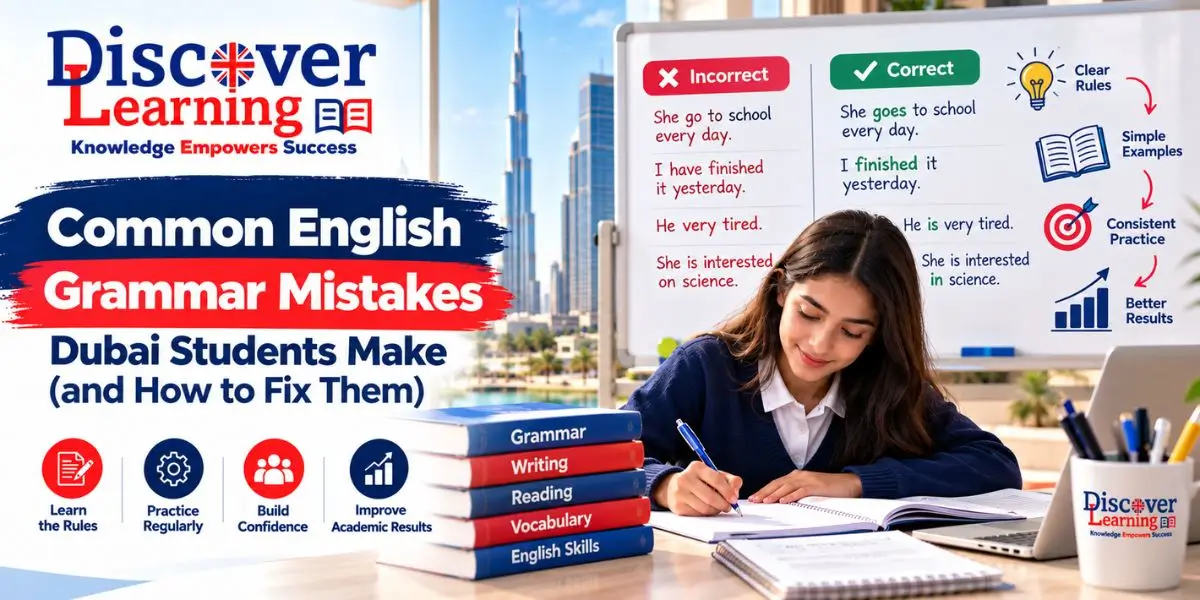
A child can speak English confidently and still lose marks because of sentences such as “She goes to school every day” or “I have finished my homework yesterday.”
These are common English grammar mistakes that can affect writing accuracy, reading comprehension, and academic performance.
For students in Dubai, learning English can involve additional challenges. Many children grow up in multilingual households, speaking Arabic, Urdu, Hindi, or another language at home while using English at school. Switching between languages is a valuable skill, but differences in grammar rules can sometimes influence how students construct English sentences.
For example, Arabic and English differ in their use of articles, verb forms, and sentence structures. However, these mistakes are not limited to Arabic-speaking students. Children from many language backgrounds can experience similar difficulties.
The good news is that grammar mistakes can often be reduced through clear explanations, consistent practice, and constructive feedback.
In this guide, we explain eight common grammar mistakes students make, why they happen, and practical ways parents can help their children improve their English at home.
1. Missing or Misusing “A,” “An,” and “The”
Articles are among the most common sources of confusion for students learning English.
Incorrect: I bought a new book.
Correct: I bought a new book.
Incorrect: Sun is very hot today.
Correct: The sun is very hot today.
English uses three main articles: a, an, and the.
- A: Used before a singular countable noun when the next sound is a consonant sound, such as “a book” or “a university.”
- An: Used before a singular countable noun when the next sound is a vowel sound, such as “an apple” or “an hour.”
- The: Used when referring to something specific, already known, or identifiable in context.
Some nouns do not need an article, particularly when speaking generally about plural or uncountable nouns. For example, “Books are useful” and “Water is important” do not require an article.
Why Do Students Make This Mistake?
Different languages use articles differently. Arabic, for example, has a definite article, but its rules do not correspond exactly to the English article system. Students may also find it difficult to decide whether they are referring to something specific or something in general.
How Parents Can Help
Ask your child to write five sentences describing objects around the house.
For example:
- There is a chair near the window.
- I have an orange in my bag.
- The television is in the living room.
Ask them to explain why each article is used. This encourages them to understand the rule rather than memorize isolated examples.
2. Subject-Verb Agreement Errors
Subject-verb agreement means that the verb must match the subject of the sentence.
Incorrect: She plays tennis every Friday.
Correct: She plays tennis every Friday.
Incorrect: My friends like football.
Correct: My friends like football.
In the present simple tense, most verbs take an additional “s” or “es” when used with he, she, or it.
| Subject | Correct sentence |
| I | I play football. |
| He | He plays football. |
| She | She watches television. |
| They | They play football. |
| We | We watch television. |
Why Do Students Make This Mistake?
Children may focus on communicating their ideas and overlook small grammatical endings. Students learning English as an additional language may also apply verb patterns from another language.
These errors can become more noticeable in longer paragraphs where students must concentrate on several writing skills at once.
How Parents Can Help
Start with the sentence “I play football.” Ask your child to rewrite it using “he,” “she,” “they,” and “we.”
This helps children recognize how the verb changes depending on the subject.
3. Mixing Up English Verb Tenses
English verb tenses can be challenging because they communicate when an action happens and how it relates to other events.
Incorrect: Yesterday we went to the mall.
Correct: Yesterday we went to the mall.
Incorrect: I have seen her yesterday.
Correct: I saw her yesterday.
The second example is particularly common because students sometimes use the present perfect with a finished time expression.
Compare these sentences:
- I went to the mall yesterday. The action happened at a specific time in the past.
- I have been to the mall before. The sentence describes a past experience without specifying exactly when.
- I was going to the mall when it started raining. An action was in progress when another event occurred.
Why Do Students Make This Mistake?
English has several tense and aspect forms, and their meanings do not always correspond directly to those used in other languages. Students may understand when something happened but struggle to select the appropriate verb form.
How Parents Can Help
Create a simple timeline with three categories: past, present, and future.
Ask your child to write one sentence about something they did yesterday, something they do regularly, and something they will do tomorrow.
For example:
- Yesterday, I visited my grandmother.
- Every day, I read a book.
- Tomorrow, I will visit the library.
Once your child becomes comfortable with these forms, introduce more advanced tenses.
4. Leaving Out “Am,” “Is,” or “Are”
Another common English grammar mistake is leaving out a necessary form of the verb “to be.”
Incorrect: He is very tired.
Correct: He is very tired.
Incorrect: They are playing outside.
Correct: They are playing outside.
In English, am, is, and are are used in several sentence structures.
For example:
- I am happy.
- She is tired.
- They are students.
- We are studying.
Why Do Students Make This Mistake?
Some languages construct present-tense sentences without an equivalent linking verb. For example, Arabic commonly uses structures that do not require a present-tense equivalent of “is” in sentences describing a person or object.
Students may transfer this pattern into English. However, omitting auxiliary verbs can also occur when children are still developing their understanding of English sentence structures.
How Parents Can Help
Give your child short sentences with missing words.
- She ___ reading.
- They ___ happy.
- I ___ learning English.
Ask them to choose between am, is, and are. Then encourage them to create their own examples.
5. Choosing the Wrong Preposition
Prepositions are small words, but they can be difficult to use accurately.
Incorrect: She is interested in science.
Correct: She is interested in science.
Incorrect: I listened to music.
Correct: I listened to music.
Other examples include:
- Good at mathematics.
- Afraid of spiders.
- Depend on someone.
- Proud of an achievement.
- Responsible for a task.
Why Do Students Make This Mistake?
Prepositions do not always translate directly between languages. A phrase that uses one preposition in a student’s first language may require a different preposition in English.
Some English combinations follow patterns, while others are best learned as complete expressions.
How Parents Can Help
Encourage your child to learn words and their common prepositions together. Instead of memorizing only “interested,” practice the phrase “interested in.”
Ask your child to create sentences such as:
- I am interested in science.
- My brother is good at football.
- She is proud of her work.
Repeatedly using these phrases in context can help students remember the correct combinations.
6. Putting Words in the Wrong Order
English sentences generally follow recognizable word-order patterns. Students may understand the meaning of individual words but arrange them incorrectly.
Incorrect: I bought a beautiful red dress.
Correct: I bought a beautiful red dress.
Another example:
Incorrect: She always is late.
Correct: She is always late.
English has conventions for arranging adjectives and placing adverbs within sentences. For example, adjectives describing opinions often appear before adjectives describing color. Similarly, frequency adverbs such as “always,” “usually,” and “often” commonly appear before a main verb but after the verb “to be.”
Why Do Students Make This Mistake?
Languages organize words differently. A student may transfer sentence patterns from their first language into English, creating sentences that sound unnatural even when the intended meaning is clear.
How Parents Can Help
Write a sentence with its words in the wrong order.
For example:
“Every morning / breakfast / she eats.”
Correct: She eats breakfast every morning.
Start with simple sentences before introducing more complex structures.
7. Confusing Countable and Uncountable Nouns
Some English nouns can be counted individually, while others are normally treated as uncountable.
Students sometimes apply plural endings to nouns that do not usually take them.
Incorrect: She gave me much advice.
Correct: She gave me a lot of advice.
Incorrect: I need information.
Correct: I need some information.
Common uncountable nouns include advice, information, equipment, furniture, homework, and research.
For example, students should normally say “some homework” rather than “three homeworks.”
When referring to individual units, English often uses phrases such as “a piece of advice” or “two pieces of information.”
Why Do Students Make This Mistake?
A noun that is countable in one language may be uncountable in English. Students may also assume that every noun can form a plural by adding “s.”
How Parents Can Help
Create two columns labelled “Countable” and “Uncountable.”
Give your child words such as “apple,” “water,” “book,” “advice,” “chair,” and “information.” Ask them to place each word in the correct column and create a sentence using it.
This helps children understand the difference through examples.
8. Run-On Sentences and Weak Punctuation
Grammar is not only about choosing the right words. Sentence structure and punctuation are also important for clear writing.
Consider this example:
Incorrect: I finished my homework I called my friend we played a game.
Correct: I finished my homework. Then I called my friend, and we played a game.
Another common error is joining two complete sentences using only a comma.
Incorrect: I was tired, I went to bed.
Correct: I was tired, so I went to bed.
Students may also forget capital letters, full stops, commas, and question marks.
Why Do Students Make This Mistake?
Children sometimes write the way they speak. In conversation, pauses, tone, and facial expressions help listeners understand where one idea ends and another begins.
Written English requires punctuation and sentence structure to communicate these relationships clearly.
How Parents Can Help
Use the one complete idea test.
Ask your child to read their writing aloud. Whenever a complete idea finishes, ask whether the sentence should end there.
Encourage them to check every sentence for three things:
- Does it begin with a capital letter?
- Does it express a complete idea?
- Does it end with appropriate punctuation?
This simple routine can improve sentence clarity over time.
How Parents Can Help Children Improve English Grammar at Home
Correcting every grammar mistake a child makes is not always the most effective approach. Children need opportunities to practice, make mistakes, understand corrections, and apply what they have learned.
A short, consistent routine can be more manageable than long grammar exercises.
Try This 10-Minute Grammar Practice Routine
- Choose a familiar topic. Ask your child to write five to eight sentences about school, hobbies, family, or something they enjoyed.
- Focus on one grammar rule. Select articles, verb tenses, punctuation, or another recurring difficulty.
- Encourage self-correction. Ask your child to identify possible mistakes before you point them out.
- Explain the correction. Discuss why the corrected sentence is more accurate.
- Rewrite the sentence. Have your child apply the rule correctly.
- Review it later. Revisit the same grammar point after a few days to see whether the improvement continues.
Practising for 10 minutes two or three times a week can help children develop greater awareness of their writing without making grammar feel overwhelming.
Keep a Simple Grammar Error Log
An error log can help parents and children identify recurring mistakes.
| Common error | Correction | Grammar rule |
| She go | She goes | Third-person singular |
| An advice | Some advice | Uncountable noun |
| Interested on | Interested in | Correct preposition |
| He happy | He is happy | Verb “to be” |
| Yesterday I go | Yesterday I went | Past simple tense |
Review the log regularly and encourage your child to correct similar errors independently.
The aim is not perfect grammar in every sentence. It is to help students recognize their mistakes and become more confident writers.
When Should Parents Consider an English Tutor?
Occasional grammar mistakes are a normal part of language development. However, additional support may be useful when the same errors continue despite regular practice or begin affecting school performance.
Consider structured English tuition if your child:
- Understands ideas but struggles to express them clearly in writing.
- Frequently loses marks because of grammar and punctuation errors.
- Finds it difficult to organize paragraphs or essays.
- Avoids writing activities because of low confidence.
- Needs additional support with English as an additional language.
- Is preparing for IGCSE, GCSE, IB, or another curriculum-based assessment.
- Has several learning gaps and needs help identifying which ones to address first.
Experienced English tutors can assess recurring mistakes and develop lessons around the student’s specific needs.
For example, a child who struggles mainly with verb tenses may benefit from targeted sentence-building exercises, while another who finds academic writing difficult may need support with paragraph structure, vocabulary, and grammar accuracy.
The most useful starting point is understanding why the mistakes occur rather than simply assigning more worksheets.
How Discover Learning Tutors Supports English Development
Discover Learning Tutors provides academic English support for students across different ages and curricula, including primary and secondary learners.
Its English programs cover reading, writing, speaking, comprehension, and grammar, with learning plans tailored to students’ needs.
The center offers one-to-one and small-group learning options, including in-person and online lessons, subject to current program availability.
Parents comparing tutors in Dubai should consider teacher qualifications, curriculum experience, lesson structure, and how student progress is assessed.
An initial assessment can help identify whether a child’s main difficulties involve grammar rules, sentence construction, reading comprehension, or more advanced academic writing.
This makes it easier to create a learning plan focused on the areas that need the most attention.
Additional Academic Support
English is only one part of a child’s academic development. Families who also need subject-specific support can consider math tutors in Dubai for help with mathematical concepts, problem-solving, and curriculum-based preparation.
Choosing support based on each subject’s learning requirements can help children develop stronger foundations across their studies.
Frequently Asked Questions About English Grammar Mistakes
What Are the Most Common English Grammar Mistakes Students Make?
Common mistakes include incorrect verb tenses, subject-verb agreement errors, missing articles, wrong prepositions, incorrect word order, and punctuation problems. The frequency of these errors varies depending on the student’s age, language background, and English proficiency.
Why Do Students in Dubai Struggle With English Grammar?
Dubai has a multilingual student population. Some learners use different languages at home and school, which can influence sentence construction and grammar choices. However, grammar difficulties also occur among students who primarily speak English.
How Can I Improve My Child’s English Grammar at Home?
Encourage short writing exercises, reading, sentence correction, and regular review of recurring mistakes. Focus on one grammar rule at a time and give your child opportunities to correct errors independently.
How Long Does It Take to Improve English Grammar?
Progress depends on the child’s current level, the type of mistakes they make, how frequently they practice, and the quality of feedback they receive. Some recurring errors may improve with focused practice, while broader writing accuracy develops over a longer period.
Is Private English Tuition Better Than Group Classes?
Neither format is automatically better. One-to-one lessons can provide targeted attention for specific grammar difficulties, while small-group lessons offer opportunities for discussion, communication, and shared learning. The right option depends on the student’s needs and confidence.
Can Grammar Mistakes Affect IGCSE or IB Results?
Yes. Written accuracy, sentence clarity, and appropriate language use can influence performance in assessments where these skills are evaluated. The impact depends on the subject, task, and relevant marking criteria.
Help Your Child Build Stronger English Grammar Skills
English grammar improves when children understand the rules, recognize recurring mistakes, and practice applying corrections in everyday writing.
Parents can support this process through short exercises, reading activities, and constructive feedback. However, when grammar difficulties persist or begin affecting academic performance, structured teaching may help address the underlying gaps.
Discover Learning Tutors offers English learning support designed around students’ individual needs, with options for different ages, abilities, and curricula.
Book an English trial session with Discover Learning Tutors to discuss your child’s grammar difficulties and identify a suitable plan for clearer writing, stronger language skills, and greater confidence.