
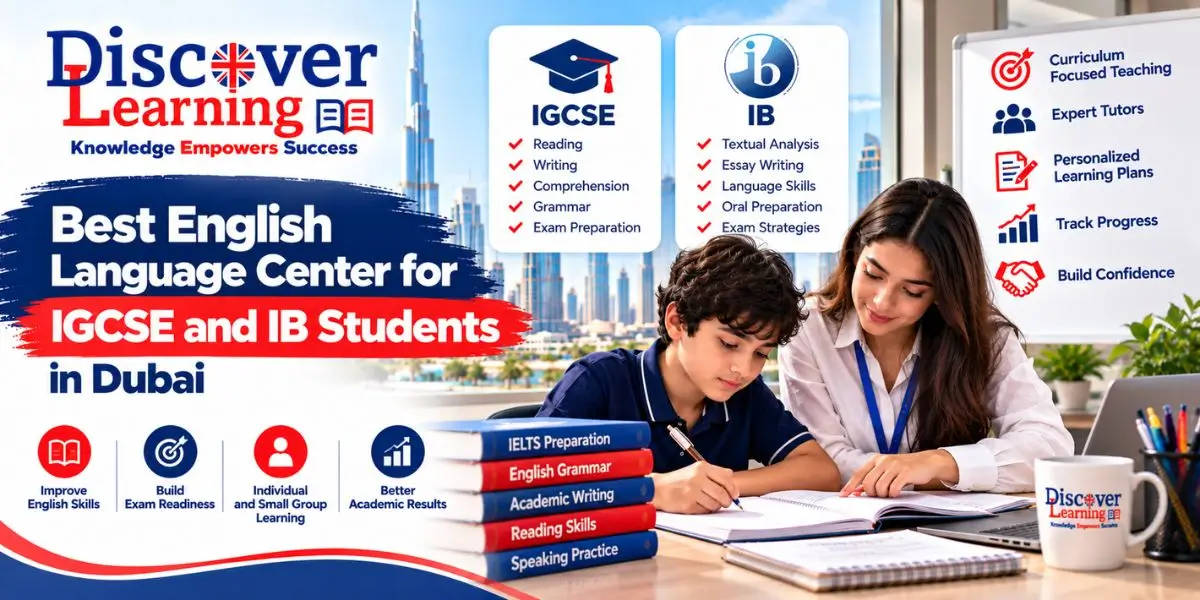
Choosing the best English language center for IGCSE and IB students in Dubai involves more than finding a center that teaches grammar, vocabulary, and essay writing. Parents need to know whether the teaching approach matches their child’s curriculum, assessment requirements, and current academic challenges.
IGCSE English, IB English A, and IB English B develop different language and academic skills. A student may communicate confidently in everyday situations but struggle with textual analysis, essay organization, inference, or examination questions. Another student may understand written texts but find it difficult to express ideas clearly in writing or speaking assessments.
For this reason, effective English tuition should go beyond general language practice. It should help students understand what their course requires, identify the skills they need to improve, and practice applying those skills in relevant academic tasks.
For parents comparing English language centers in Dubai, the starting point should be curriculum alignment, individual learning needs, and the quality of teaching and feedback.
What Is the Best English Language Centre for IGCSE and IB Students?
The best choice is a center that understands the student’s specific program and can explain how its teaching approach supports the required learning outcomes.
Before enrolling, parents should check whether the center:
- Supports the student’s exact IGCSE syllabus or IB English course.
- Understands the relevant assessment structure and criteria.
- Assesses existing strengths and weaknesses before planning lessons.
- Teaches analytical reading and academic writing where required.
- Provides practice using appropriate question types and text formats.
- Gives specific, actionable feedback on written and spoken work.
- Monitors progress and adjusts the learning plan when necessary.
These details matter because IGCSE First Language English, IGCSE English as a Second Language, IB English A, and IB English B are not interchangeable courses.
A program that focuses mainly on grammar and vocabulary may be useful for some learners but insufficient for students who need advanced textual analysis, comparative writing, or assessment-specific preparation.
If your child needs IGCSE or IB English tuition in Dubai, DLT can be approached to discuss the student’s course, current challenges, and academic goals before deciding on a suitable preparation plan.
Understanding the Differences Between IGCSE and IB English
Both programmes require students to develop effective communication and comprehension skills. However, the emphasis varies according to the subject and course pathway.
Understanding these differences helps parents identify the type of support their child may need.
IGCSE First Language English
IGCSE First Language English develops students’ ability to understand, interpret, and communicate ideas effectively. Depending on the syllabus and assessment route, students may be required to analyze texts, identify meaning and effects, organize information, and produce writing for different purposes and audiences.
Students often need to work on:
- Understanding explicit and implied meanings.
- Selecting relevant information and textual evidence.
- Analyzing language choices and their effects.
- Organizing ideas into coherent written responses.
- Adapting tone, style, and vocabulary to the task.
- Improving grammatical accuracy and sentence control.
For these students, learning grammar rules is only one part of preparation. They must also understand how to apply language skills when responding to unfamiliar texts and completing structured writing tasks.
IGCSE English as a Second Language
IGCSE English as a Second Language is designed for learners developing their ability to use English effectively in different contexts. The precise skills and assessment components depend on the examination board and syllabus.
Students may need support with reading comprehension, listening accuracy, vocabulary, written communication, and speaking, where included in their assessment route.
The teaching approach should reflect the learner’s existing English proficiency and the requirements of their specific course.
This is why parents should confirm whether the center supports the exact syllabus their child is studying rather than assuming all IGCSE English courses follow the same structure.
What Is the Difference Between IB English A and IB English B?
At the IB level, choosing the correct type of English support is particularly important because English A and English B have different educational objectives.
IB English A: Language and Literature
IB English A: Language and Literature examines how language, texts, and context shape meaning. Students work with literary and non-literary texts and develop the ability to interpret choices made by writers and creators.
Depending on the course and assessment component, students may need help with:
- Close reading and textual interpretation.
- Analyzing language, structure, tone, and stylistic choices.
- Developing clear, evidence-based arguments.
- Comparing texts and perspectives.
- Organizing analytical essays.
- Preparing for individual oral assessments.
- Responding effectively to unfamiliar texts.
Students may understand the general meaning of a text but struggle to explain how particular choices influence the reader or contribute to a wider interpretation.
Effective tuition should help them move beyond describing what a text says to explaining how it creates meaning and why that matters.
IB English B: Language Acquisition
IB English B is a language-acquisition course for students who already have experience with English. It develops receptive, productive, and interactive communication skills through different themes and text types.
Students may need help with:
- Reading and interpreting different texts.
- Understanding spoken English.
- Developing vocabulary and grammatical control.
- Writing for different purposes and audiences.
- Communicating clearly in speaking activities.
- Preparing for the relevant oral and written assessments.
At a higher level, students also study literary works originally written in the target language. The exact demands depend on the course level and applicable assessment requirements.
The central distinction is that English A places substantial emphasis on critical textual interpretation, while English B focuses on developing language proficiency and communication, alongside its prescribed course requirements.
A suitable support program should reflect these differences instead of teaching both courses through the same generic English lessons.
What Should Parents Look for in an English Language Centre in Dubai?
Once you understand your child’s curriculum, the next step is to evaluate how a center delivers its teaching.
1. Support for the Exact Syllabus
Start by confirming the examination board, subject, syllabus, level, and assessment pathway.
Ask the center to explain how lessons will address the requirements of that specific course. If the teaching plan does not change according to the student’s syllabus, the support may be too general.
2. An Initial Assessment of Learning Needs
Two students in the same year group can struggle for completely different reasons.
One student may understand a text but write poorly organized essays. Another may produce accurate sentences but struggle to interpret implied meaning. An IB English B student may perform well in reading while needing additional speaking practice.
An initial assessment helps establish these differences and gives the tutor a basis for prioritizing lessons.
3. Teaching Linked to Assessment Criteria
Students need to understand not only what a good answer looks like but also why it meets the task requirements.
For example, a student writing an analytical response should understand the difference between identifying a technique and explaining its effect. A student completing a writing task should understand how purpose, audience, organization, and language choices influence the quality of the response.
Teaching should connect these expectations to relevant assessment criteria and syllabus requirements.
4. Specific Feedback and Opportunities to Improve
General comments such as “write more” or “improve your vocabulary” do not always show students what to do next.
Useful feedback identifies the weakness, explains its effect on the response, and provides a practical way to improve it.
A productive learning cycle looks like this:
Attempt → Feedback → Correction → Further Practice → Progress Review
Students should have opportunities to apply feedback in new tasks. This helps establish whether they have understood the lesson rather than simply corrected one assignment.
5. Appropriate Exam Practice
Past papers and exam-style questions are important, but their value depends on how they are used.
Students with significant skill gaps may benefit from focused teaching before completing full examination papers. As their skills become more consistent, timed practice can help develop pacing, accuracy, and familiarity with assessment conditions.
A well-planned program balances skill development, guided practice, independent work, and exam preparation.
6. Transparent Lesson Structure and Progress Tracking
Parents should understand what lessons will cover, how progress will be reviewed, and what happens if the student does not improve as expected.
Ask whether the center provides regular feedback, tracks recurring mistakes, and adjusts lesson priorities according to performance.
The goal is not simply to complete a set number of sessions. It is to help the student develop skills they can apply independently in classwork and assessments.
How DLT Can Support IGCSE and IB English Students
DLT’s English support can be discussed in relation to the student’s curriculum, current ability, and academic goals. Before choosing a program, parents should establish which skills need attention and what kind of teaching would be most appropriate.
Depending on the student’s requirements, priorities may include:
- Reading comprehension and interpretation.
- Grammar, vocabulary, and sentence construction.
- Academic and analytical writing.
- Essay planning and paragraph development.
- Textual analysis and evidence-based arguments.
- Speaking and oral assessment preparation.
- Examination techniques and timed practice.
The emphasis should be on identifying the areas that are limiting performance and using relevant practice to address them.
For example, a student struggling with analytical writing may need guided text analysis and structured feedback. A student developing English proficiency may benefit more from targeted language practice and opportunities to improve comprehension and communication.
Parents should ask DLT about the availability of support for their child’s specific syllabus, the structure of lessons, and how progress will be assessed before selecting a program.
This creates a clearer starting point and helps families determine whether the proposed teaching approach matches the student’s needs.
Questions to Ask Before Enrolling Your Child
Before paying for an English course, use the following checklist to compare centres.
- Curriculum: Do you support my child’s exact IGCSE syllabus or IB English course?
- Assessment: How will you identify their current strengths and weaknesses?
- Teaching plan: Will lessons reflect the course’s assessment requirements?
- Writing feedback: Will my child receive detailed corrections and opportunities to revise their work?
- Speaking support: Is oral preparation included when it is relevant to the course?
- Practice materials: Are the questions and texts appropriate for the student’s syllabus and level?
- Progress monitoring: How will improvement be measured?
- Communication: How often will parents receive feedback?
- Class format: Are lessons individual, small-group, or larger classes?
- Fees: What is included in the course price, and are assessments, materials, or additional sessions charged separately?
These questions can help parents distinguish between a general English course and a program designed around specific academic requirements.
When comparing English tutors, focus on curriculum knowledge, teaching methods, the quality of feedback, and evidence of progress rather than relying solely on promotional claims.
Choosing Between Individual and Group English Tuition
The most suitable lesson format depends on the student’s needs, learning preferences, and the support available.
Individual Tuition
One-to-one lessons can allow the tutor to focus closely on a student’s specific difficulties, adapt explanations, and provide individual feedback.
This format may be particularly useful when a student has significant gaps in analytical writing, needs targeted examination preparation, or requires a flexible pace.
Small-Group Tuition
Small-group lessons can provide opportunities for discussion, collaborative analysis, and learning from other students’ approaches. They may also offer a structured environment for practicing communication and sharing ideas.
However, the suitability of group tuition depends on the group size, lesson structure, and whether the teaching can still address individual learning needs.
Parents should ask how the center determines the appropriate format and whether the arrangement can be reviewed if the student’s needs change.
How to Choose the Right English Language Centre for IGCSE and IB
There is no single center or teaching format that is automatically the best choice for every student. The right option depends on the course, the student’s current skills, the quality of instruction, and the support required to make progress.
IGCSE First Language English students may need help with interpretation, language analysis, and writing. IGCSE English as a Second Language students may need more targeted language development. IB English A students often require critical analysis and evidence-based argumentation, while IB English B students need support aligned with language acquisition and communication.
When comparing tutors in Dubai, start by checking whether they understand your child’s exact course and can explain how their lessons will address its requirements.
Consider the teaching plan, feedback process, lesson format, progress reviews, and overall cost together. A clear explanation of how the program will help your child is more useful than a broad promise of better grades.
Speak with DLT about your child’s IGCSE or IB English requirements, current learning challenges, and academic goals to discuss a suitable support plan.