
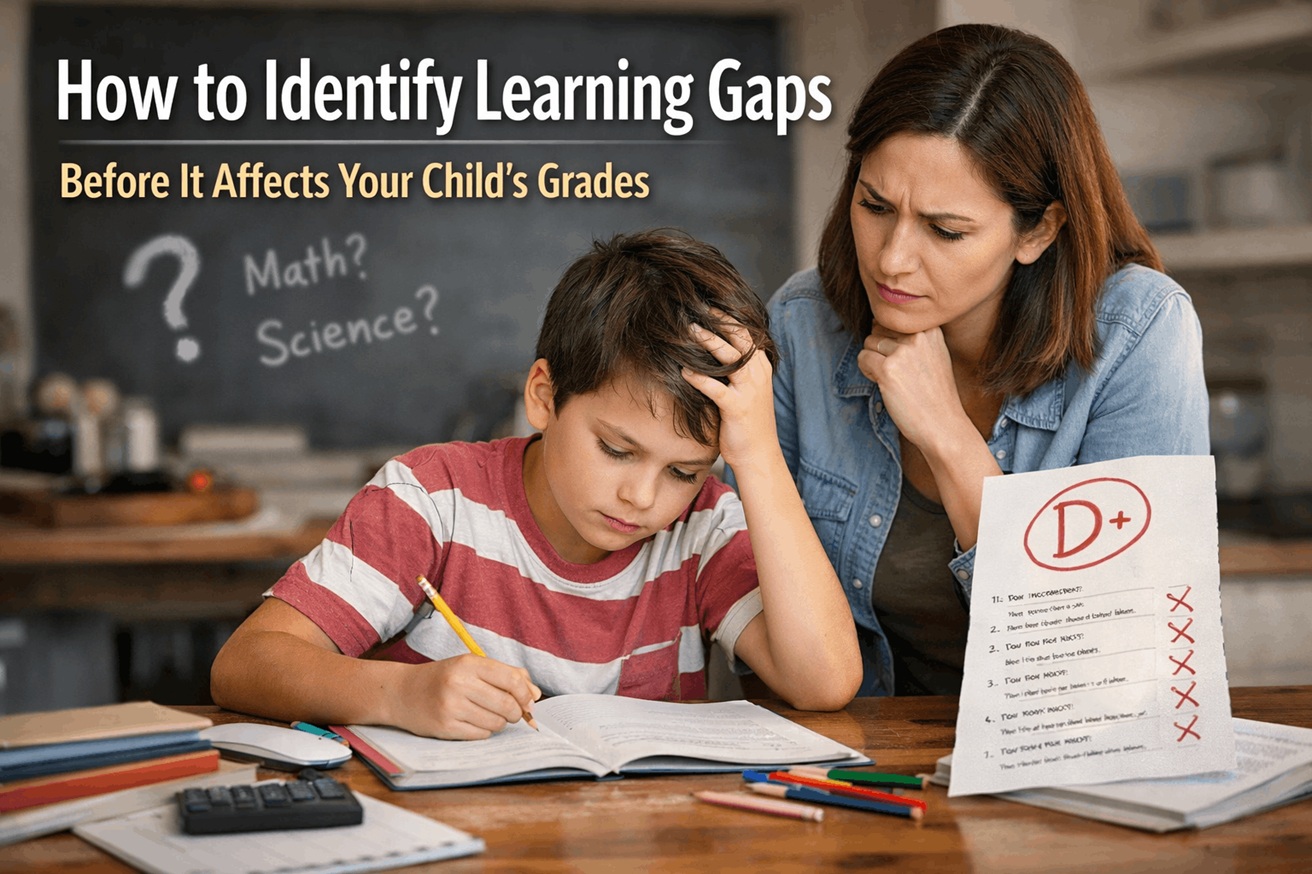
Every parent assumes that their child is learning exactly what they should, as long as they are attending their school regularly, finishing their homework, and passing exams. But many students carry undetected learning gaps, for instance, minor misconceptions that gradually escalate into significant academic difficulties. These learning gaps have resulted in prolonged academic difficulties ranging from months to years, leading to a decline in the child’s performance.
One of the best strategies to safeguard your child’s academic confidence and long-term success is to identify learning gaps early. In this article, we will be discussing the learning gaps, why they arise, how they harm your child, and how parents, educators, and tutors like us (Discover Learning Tutors) can address them before they hurt your child’s grades.
Understanding What Learning Gaps Really Mean for Your Child
The discrepancy between what a student has truly mastered and what is expected of them at their grade level is known as a learning gap. These gaps may occur in a single topic, such as English or Mathematics, or across multiple subjects.
Learning functions similarly to building blocks. Every idea builds upon the one before it. And so, when lessons become more complex, students struggle to cope up if they lack the fundamental skills such as basic number sense, reading comprehension, or grammar. These gaps grow over time, making learning more difficult and perplexing.
Therefore, it becomes necessary to distinguish between achievement gaps and learning gaps. Learning gaps concentrate on personal comprehension and mastery, whereas achievement disparities are related to opportunity and access. The good news is that with the proper support, learning gaps can be identified and addressed.
Early Warning Signs That Your Child May Be Falling Behind
It is rare for learning gaps to develop suddenly. They take time to manifest and are frequently overlooked until academic pressure mounts over the child. Some of the common early signs of learning difficulties include:
- Homework is taking much longer than anticipated.
- Frequent tears, annoyance, or avoidance of schoolwork
- A sudden distaste for subjects your youngster used to love
- Inability to articulate ideas in their own words
- Excellent achievement in class, but subpar test scores
- Instructors bringing up incomplete assignments or low participation
It’s possible that kids don’t always communicate their weakness over a subject. Instead, they might describe a topic as “boring” or assert that they are “bad” at it. These remarks by the child reveal the fundamental knowledge deficiencies the kid is facing.
Common Reasons Why Learning Gaps Develop in School Years
Well, you would be amazed to know that even in encouraging educational settings, learning gaps in children can arise and there are hidden reasons to it!
Pace is one crucial factor. Since in an educational setting, lessons proceed regardless of whether all students have fully understood the material. Classrooms adhere to a prescribed curriculum. And even if a child has trouble grasping an early idea, the class nonetheless moves along, leaving gaps.
Additionally, different learning styles are essential. Some kids learn best through visual aids, while others learn best through practice or repetition. Understanding may be lacking if teaching strategies are not aligned with a child’s preferred learning style.
Illness, repeated absences, and school transfers are also examples of study disruptions that may affect students. Additionally, post-pandemic learning loss has had a significant influence on students all across the world, with research demonstrating concentration delays in reading and math abilities.
Apart from these, there are emotional factors like anxiety, low confidence, or fear of asking questions can further prevent children from seeking help when they need it most.
How Learning Gaps Impact Grades, Confidence, and Motivation
Learning gaps that are not filled do not go away over time. Instead, they grow as the subjects become more complex. Algebra may become too much for a child’s academic struggles with fundamental fractions. Performance in many subjects, including science and the humanities, can be impacted by poor reading comprehension.
Learning gaps affect confidence as well as grades. Children who struggle to learn lessons often feel embarrassed, anxious, or discouraged. This might eventually result in learning avoidance, decreased desire, and the conviction that they are “not smart enough”; thereby resulting in demotivation.
Rebuilding a good relationship with learning, boosting academic performance, and restoring confidence are all made possible by addressing learning gaps early.
Simple Ways Parents Can identify learning gaps early at Home
As parents, you can greatly help by understanding the early symptoms of a child’s diffused concentration. You can help by:
- Examining assignments and previous exams for recurring errors
- Ask your child to use basic language to communicate ideas
- Examining study techniques and emotional reactions to assignments
- Using brief diagnostic tests or evaluations based on skills
- Keeping teachers informed about your development regularly
If your child avoids studying or gets easily irritated, it’s usually a sign of confusion rather than laziness- and this must not be ignored. Early signs of learning difficulties discussions and observation might identify areas that require additional assistance and will definitely result in resolving the academic performance issues in students.
How Discover Learning Tutors Accurately Identify Learning Gaps
To find learning gaps in the classroom, our teachers use exams, observations, and participation trends of the students. Large class sizes, however, may restrict individualised attention, therefore, we focus on concentration of the batch.
To identify the precise areas where comprehension falters, our tutors employ focused evaluations, one-on-one conversations, and guided practice sessions with the child as well as with the parents. We also find gaps that regular assessments might miss by concentrating more on fundamental concepts and ideas.
To precisely and effectively detect gaps, at Discover Learning Tutors, we employ systematic diagnostic techniques and individualised learning plans, making sure that no idea is overlooked or taken for granted.
Closing Learning Gaps Early with the Right Academic Support
A learning gap is easier to close the earlier it is addressed. Children who receive targeted and individualized academic support can relearn the concepts and topics they have otherwise missed at their own pace, free from any criticism or pressure.
Lessons with us are tailored to a child’s learning style through one-on-one tuition and mentoring, ensuring that ideas are fully understood before proceeding. Progress becomes apparent with consistent observation and feedback, which increases self-assurance and drive.
The skilled team at Discover Learning Tutors concentrate on developing long-term academic skills, solidifying understanding, and fortifying foundations. Students who receive individualised coaching and professional advice not only raise their grades but also rebuild their self-confidence.
Final Thoughts
Taking action right away might make all the difference if you notice signs of your child’s academic struggles. Your child may close all the learning gaps and lay solid foundations, thereby proceeding with confidence if they receive the proper direction, support, and professional tutoring from Discover Learning.
Because every child deserves to understand, develop, and succeed; and not just to keep up!